Gripper-frame canonicalization on LIBERO
In summer 2026 I worked at Princeton with Christine Allen-Blanchette on reference frames for robot manipulation policies.
Background
A policy that learns to pick up a bowl from demonstrations should still work if the bowl is moved or turned on the table. If the policy sees the scene in fixed world coordinates, though, a moved bowl looks like a new input it was never trained on.
Canonicalization is one way around this. Before the policy sees anything, you re-express the scene in a reference frame attached to something that moves along with the task, such as the objects or the robot's hand. If the frame moves with the bowl, a shifted or rotated bowl looks the same to the policy as one in the training position. Dym, Lawrence, and Siegel give a formal treatment of this idea and its limits.
Frames can account for different amounts of symmetry. A planar frame only handles sliding along the table and turning about the vertical axis (yaw). A full SE(3) frame handles every 3D rotation and translation, including tilt. Earlier experiments in the group had found only modest gains from going all the way to SE(3), and I wanted to understand why.
Setup
The policy is an adapted PointFlowMatch. A PointNet encoder reads a 512-point cloud from two cameras, and a 1D U-Net generates a short sequence of actions with flow matching: it starts from noise and follows a learned velocity field toward a plausible action sequence. The robot executes one action and then replans.
I trained a separate policy on each of ten tasks from LIBERO Spatial, a simulated manipulation benchmark, with 50 demonstrations per task. I compared four frames:
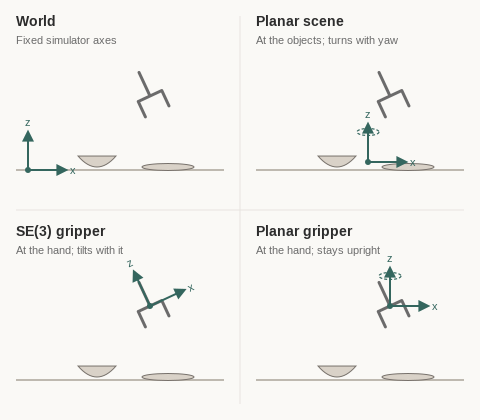
Side view. The planar scene and planar gripper frames also turn with the yaw of the objects or hand.
| Frame | Attached to | Used in |
|---|---|---|
| World | Fixed simulator axes | Ten-task comparison |
| Planar scene | Initial object layout, fixed for the episode | Ten-task comparison |
| SE(3) gripper | Hand position and full 3D orientation | Ten-task comparison; action targets in the control |
| Planar gripper | Hand position and yaw; height and tilt stay in world terms | Observations in the control; baseline action targets |
The frame applies to actions as well as observations. The world policy predicts absolute target poses in world coordinates, and the planar scene policy predicts absolute targets in its scene frame, so height and tilt stay in world terms. The SE(3) gripper policy writes each step relative to the previous one, in the hand's own frame.
To test whether a policy handled moved scenes, I rotated each starting layout by ±10°, ±20° or ±30° of yaw and shifted it 10 cm horizontally. With 12 starting layouts and six angles per task, that's 720 attempted trials per policy across the ten tasks. Some setups were rejected before the policy ran: the hand had to reach its transformed start within 1 cm, and objects couldn't drift or change height by more than 3 cm. That left 679 valid trials.
Results on ten tasks
| Policy frame | Successes | Success rate |
|---|---|---|
| World | 0/679 | 0.0% |
| SE(3) gripper | 390/679 | 57.4% |
| Planar scene | 478/679 | 70.4% |
The world-frame policy failed every moved trial, which is the problem canonicalization is meant to address. The gripper frame recovered much of that, but it still finished 13 points behind the simpler planar scene frame.
With no moves, the three policies are close: world 212/232 (91.4%), SE(3) gripper 200/232 (86.2%) and planar scene 210/232 (90.5%), pooled from the untransformed trials in the evaluation sweeps. All three learned the tasks about equally well, so the 13-point gap is mostly about how they handle moved scenes.
The gap isn't spread evenly across tasks:
| Task (pick up the black bowl …) | SE(3) gripper | Planar scene |
|---|---|---|
| on the cookie box | 55.6% | 94.4% |
| between the plate and the ramekin | 51.5% | 83.3% |
| next to the plate | 57.4% | 83.3% |
| in the top drawer of the wooden cabinet | 61.1% | 80.6% |
| on the stove | 47.2% | 63.9% |
| on the wooden cabinet | 65.3% | 79.2% |
| next to the ramekin | 80.6% | 84.7% |
| on the ramekin | 69.4% | 68.1% |
| next to the cookie box | 11.1% | 5.6% |
| from the table center | 80.0% | 63.6% |
The scene frame leads by 14 to 39 points on six tasks. Two are close. The gripper frame wins on "from the table center" by 16 points, and on "next to the cookie box", where both policies mostly fail. Each task has 54 to 72 valid trials, so single-task differences are noisy.
The cookie-box task shows the largest gap. Here are the two policies on the same starting layout, rotated 10° and shifted 10 cm. The dots are the 512-point cloud the policy actually sees.
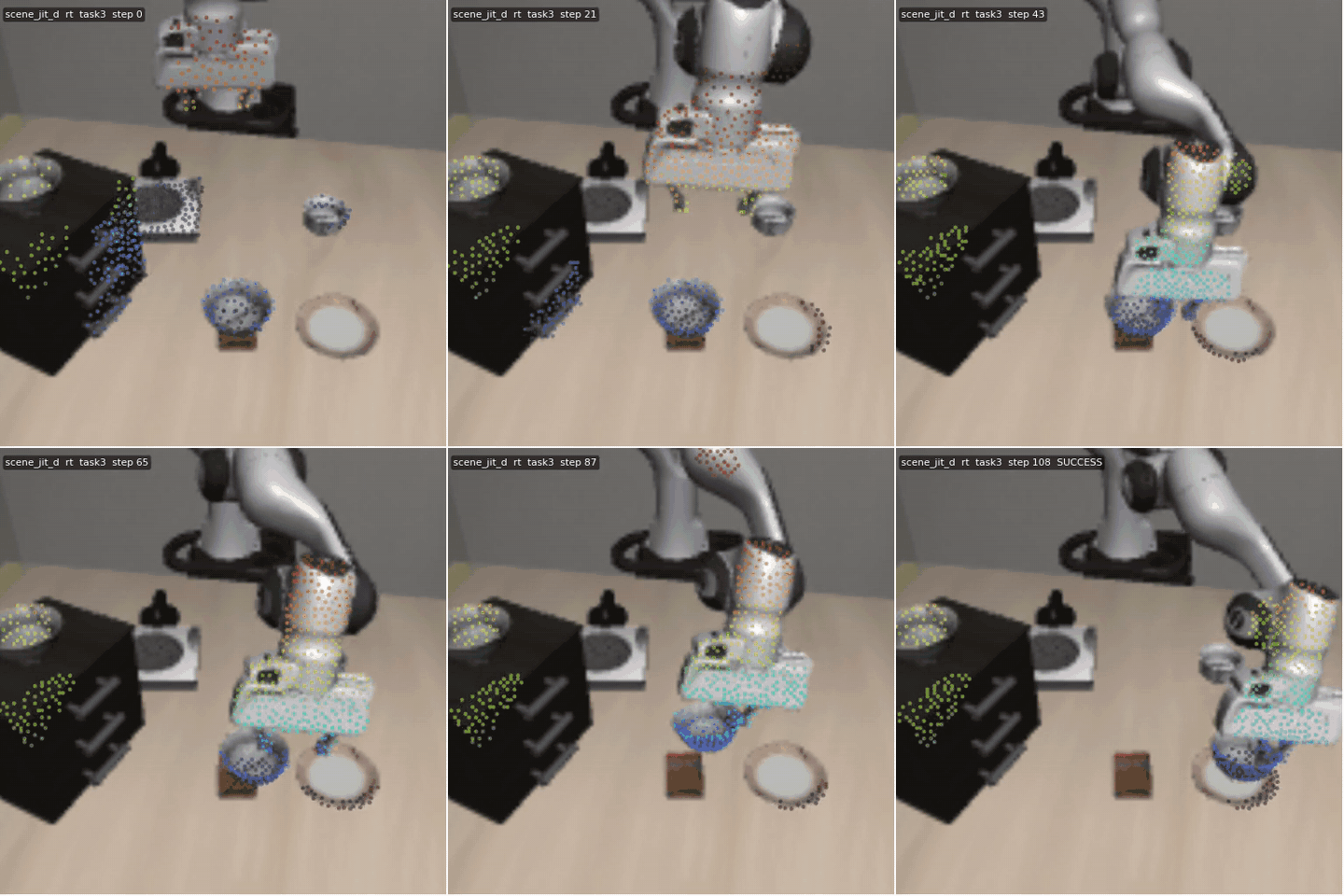
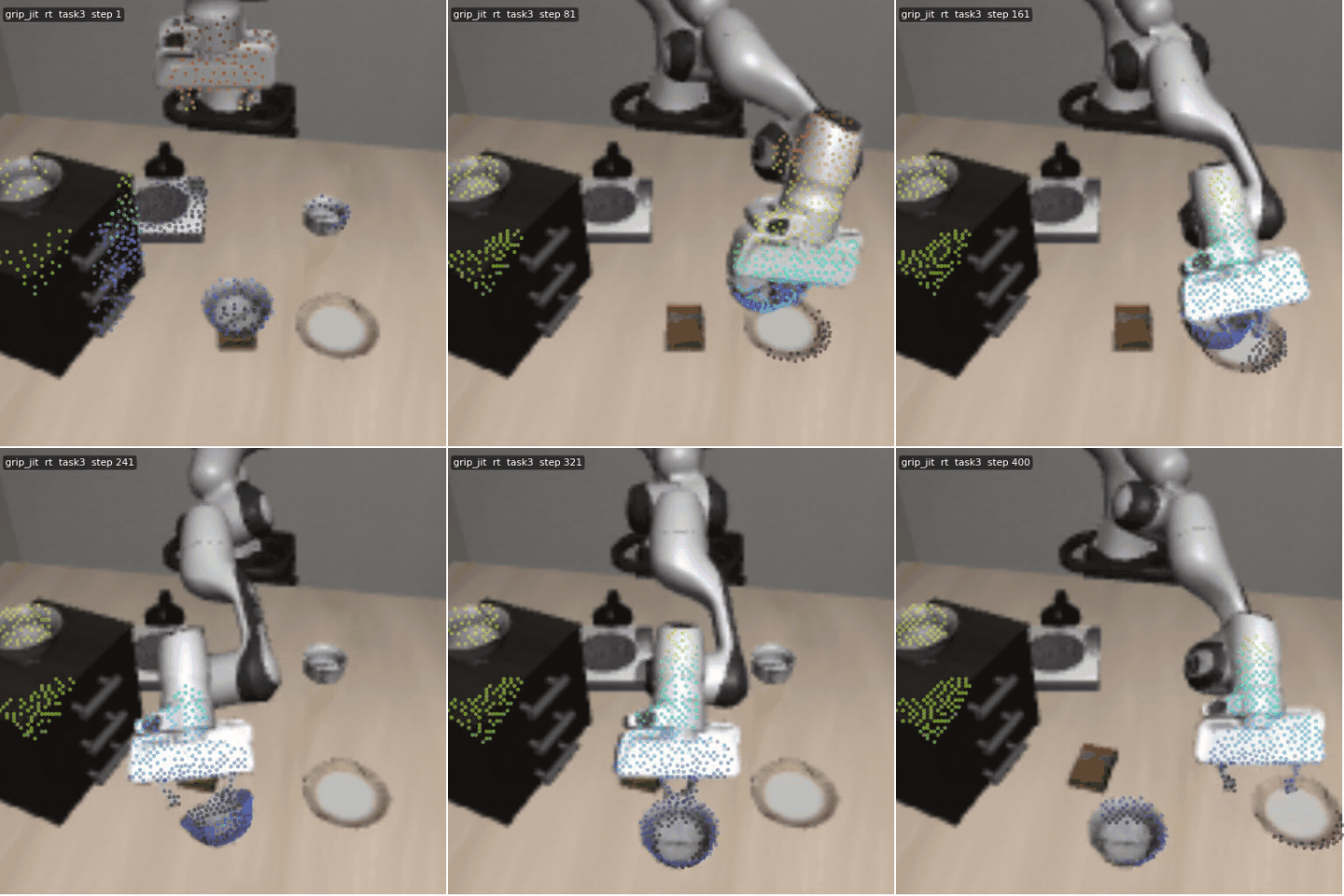
Left: the planar scene policy succeeds at step 108. Right: the SE(3) gripper policy fails and runs out the 400-step limit (shown at 2× speed).
This comparison is rough. Each task had one training run, the methods didn't share evaluation random seeds, and the test moves were all planar, so these numbers say nothing about arbitrary 3D rotations.
Action-coordinate control
Compared with the planar baselines, the SE(3) gripper policy changes two things: what the policy sees, and the coordinates its actions are written in. To separate these, I took one task (pick up the black bowl on the cookie box and place it on the plate) and kept the observations fixed in the planar gripper frame. Only the action targets changed.
With planar gripper targets, a motion is described in upright axes centered on the hand. With full gripper targets, it is described in the hand's own axes, so "move along the hand's axis" means the same thing whether or not the hand is tilted.
| Action targets | Successes | Success rate |
|---|---|---|
| Planar gripper | 47/72 | 65.3% |
| Full gripper | 67/72 | 93.1% |
| Full gripper, coupled | 69/72 | 95.8% |
Here all three policies saw the same 12 layouts, six yaw angles, 10 cm shift and evaluation seeds, so the rows are directly comparable. Switching to full gripper targets improved success by 27.8 points, with a 95% interval of 9.7 to 45.8.
The third row tests a training detail. During training I randomly perturb the observation frame by about 1 cm and 0.05 rad as augmentation. The coupled variant applies the same perturbation to the action frame, so observations and actions stay consistent with each other. That added 2.8 points, with an interval of −6.9 to 16.7, so I can't say coupling helps.

The intervals come from resampling the 12 starting layouts, keeping each layout's six trials together. They describe these particular trained policies, not variation between training runs.
This doesn't explain the ten-task gap on its own. Full gripper targets helped a lot on the bowl task, yet the full SE(3) gripper policy trailed across ten tasks. The two setups also differ in other ways: the control keeps planar observations and writes every target relative to the current hand, while the original gripper policy uses full SE(3) observations and writes each step relative to the previous one. I'd treat the result as a lead on the action representation rather than an answer.
Gravity
Gravity is another possible factor. In world coordinates "down" is always the same direction, but in a tilted gripper frame its coordinates change. Expressing the scene relative to the hand also removes the hand's absolute height. Together, these mean the gripper policy no longer sees directly which way is down or how far it is above the table.
To give that information back, I added four inputs per observation step: the gravity direction expressed in the gripper frame (three numbers) and the gripper's height (one number). They are fed to the network as global conditioning, alongside the point-cloud features and proprioception, not attached to individual points. Neither changes when the scene is turned about the vertical, so they don't undo the canonicalization.
I tested this on the same bowl task with the original SE(3) gripper policy. Over the same 72 trials and seeds, it succeeded 37 times (51.4%) with gravity features and 45 times (62.5%) without. The baseline differs from the table above because this is the original SE(3) gripper policy, not the planar-gripper control. Adding gravity this way didn't help.
Next steps
The next step would be to repeat the action-coordinate control across more tasks and multiple training seeds. After that, I'd compare gripper and scene frames with matching full SE(3) action parameterizations, so the frame is the only difference. The code, raw results and handoff notes are on GitHub.
Wang et al. study local-canonicalization policies for planar swarm control, a related idea in a different setting.